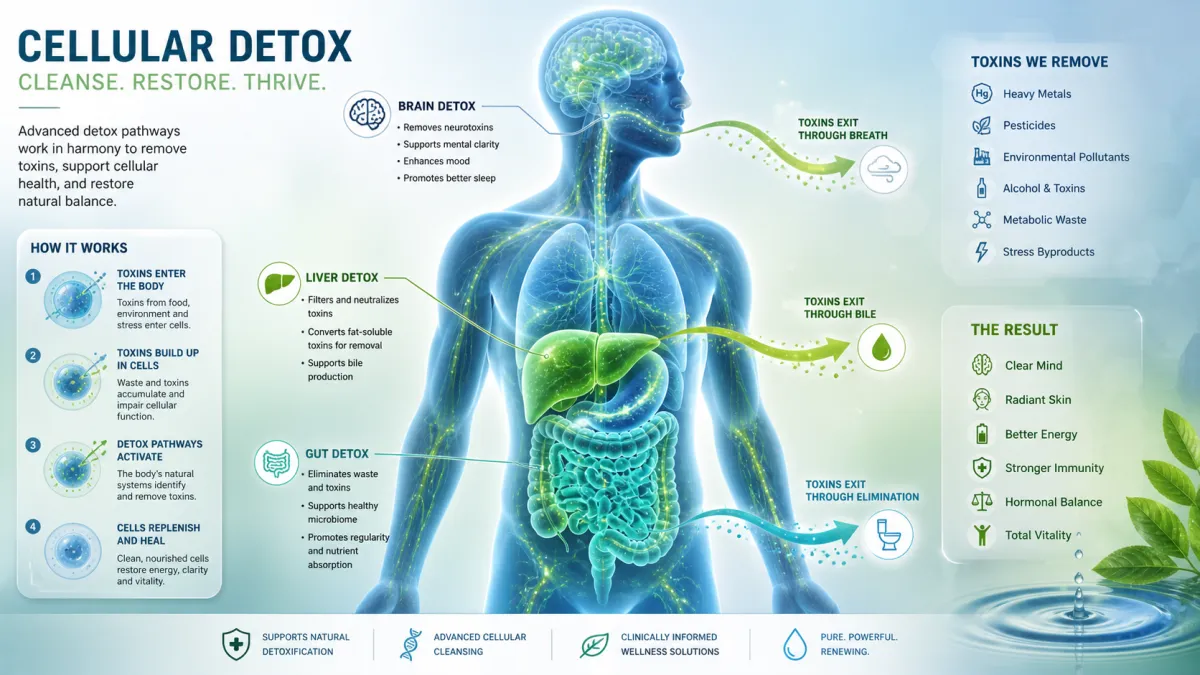
Cellular Detox Guide: Safe Detoxification at the Cellular Level
Detox has become one of the most talked-about topics in modern health. You see it everywhere—juice cleanses, supplements, teas, and programs all promising to “cleanse your body.” But here’s the truth: most detox approaches miss the mark entirely.
Your body was designed to detox. The problem isn’t that your body doesn’t know how—it’s that the modern world is overwhelming your system faster than it can keep up.
If you want real results, you must understand how detoxification actually works—at the cellular level.
Why Detox Is More Important Than Ever
We live in a world filled with toxins. These aren’t just occasional exposures—they are constant and cumulative.
Your body encounters toxins from:
Environmental pollution (air, water, soil)
Chemicals in food and agriculture
Synthetic personal care products
Household cleaners
Mold exposure
Hidden infections
Heavy metals
Even before birth, exposure begins. Toxins can transfer from mother to child, creating a burden that continues to build over time.
Your body can handle some of this load. But when exposure exceeds your ability to eliminate toxins, problems begin.
The Cellular Detox Problem
Every cell in your body produces waste as it creates energy. This is normal and necessary.
But when toxic exposure increases, two things happen:
Waste production increases
Detox capacity becomes overwhelmed
When your cells can’t efficiently eliminate toxins, those toxins begin to accumulate.
This leads to:
Fatigue
Brain fog
Hormone imbalance
Inflammation
Autoimmune symptoms
Chronic illness
Healing begins when you address detox at the source—the cell.
Why Most Detox Methods Fail
Many popular detox methods are based on incomplete or outdated ideas.
You’ve likely heard of ingredients like:
Chlorella
Cilantro
These are often marketed as powerful detox tools. But in reality, they can create more harm than good.
The Real Issue
Most detox products do one thing:
👉 They mobilize toxins—but don’t remove them.
Think of toxins like garbage in a city. A proper system collects and removes it completely.
But weak detox methods?
They just move the garbage around.
The Danger of Random Detox
When toxins are mobilized without proper removal, they can:
Re-enter circulation
Deposit deeper into tissues
Accumulate in the brain and nervous system
This can worsen symptoms and create new ones.
Many people feel worse during detox not because detox is bad—but because it’s being done incorrectly.
A safe detox must follow a structured, cellular approach.
The Foundation of Cellular Detox
A true cellular detox is built on three essential components.
1. Addressing the Cell First
If you want to get well, you must fix the cell.
Detox does not begin in the liver. It begins inside the cell.
Your cells must be able to:
Release toxins
Produce energy efficiently
Maintain membrane integrity
Without this, detox cannot happen effectively.
2. Opening Detox Pathways
Once toxins leave the cell, they must exit the body.
This requires fully functioning pathways, including:
Liver
Gut
Kidneys
If these pathways are not working properly, toxins can be reabsorbed.
This is called autointoxication—and it can make you feel significantly worse.
3. Using True Binders
Binders are critical.
They grab toxins and escort them out of the body.
Weak binders:
Release toxins too early
Allow redistribution
Strong binders:
Hold tightly to toxins
Ensure safe elimination
Without proper binders, detox becomes inefficient and potentially harmful.
The 5 R’s of Cellular Detox
A successful cellular detox follows a structured roadmap known as the 5 R’s.
R1 – Remove the Source
You must reduce exposure to toxins.
This includes:
Cleaning up diet
Reducing chemical exposure
Addressing mold or infections
You cannot detox effectively if exposure continues.
R2 – Regenerate the Cell Membrane
The cell membrane controls what enters and exits the cell.
If it’s damaged:
Toxins get stuck
Nutrients can’t enter
Restoring membrane health is essential for detox to begin.
R3 – Restore Cellular Energy
Energy drives detox.
Without proper mitochondrial function, your cells lack the energy needed to:
Process toxins
Eliminate waste
This is why fatigue is often tied to toxic burden.
R4 – Reduce Cellular Inflammation
Inflammation disrupts cellular function.
It slows detox and damages tissues.
Reducing inflammation allows your cells to function optimally again.
R5 – Reestablish Methylation
Methylation is a critical biochemical process involved in:
Detoxification
DNA repair
Hormone balance
When methylation is impaired, detox pathways slow down significantly.
The Three Phases of Cellular Detox
Detox must be done in phases. Skipping steps can lead to poor results—or even harm.
Phase 1: Preparation Phase
This phase focuses on:
Supporting detox pathways
Strengthening cellular function
Preparing the body for toxin removal
This is where most people go wrong—they skip this step.
Phase 2: Body Detox Phase
In this phase:
Strong binders are introduced
Toxins begin moving out of tissues
A concentration gradient is created
This allows toxins to move from:
👉 Areas of high concentration → areas of low concentration
This ensures safe and efficient removal.
Phase 3: Brain Detox Phase
This is the most overlooked phase.
The brain stores many toxins, especially fat-soluble ones.
This phase:
Uses targeted support for the brain
Helps remove neurotoxins
Supports neurological function
Many people who “tried everything” never addressed this phase.
Why Cellular Detox Supports Hormone and Brain Health
Toxins don’t just sit in your body—they interfere with key systems.
Hormone Disruption
Toxins can:
Mimic hormones
Block receptors
Disrupt signaling
This contributes to:
Estrogen dominance
Thyroid issues
Adrenal dysfunction
Brain and Nervous System Impact
Neurotoxins affect:
Mood
Focus
Memory
Nervous system regulation
This is why detox must include a brain phase.
Signs You May Need a Cellular Detox
You may benefit from a cellular detox if you experience:
Chronic fatigue
Brain fog
Hormone imbalances
Digestive issues
Skin problems
Autoimmune symptoms
Sensitivity to chemicals
These are often signs that your detox systems are overwhelmed.
The Right Way to Approach Detox
A safe and effective detox is:
Structured
Phased
Cellular-focused
Supported with proper tools
It is not:
Random
Aggressive
Based on trends
Dependent on weak supplements
The Role of Targeted Support
Certain tools can support the detox process when used correctly.
Examples include:
Cellular support formulas
Gut support products
Advanced binders
Brain detox support
These must be used strategically—not randomly.
Why Guidance Matters
Cellular detox is powerful—but it must be done correctly.
If you are dealing with:
Chronic illness
Hormone imbalance
Neurological symptoms
Working with a practitioner ensures:
Proper sequencing
Safe progression
Personalized adjustments
This reduces the risk of detox reactions and improves results.
The Truth About Healing
Your body was designed to heal.
But healing doesn’t happen by chance—it happens when you remove interference.
Toxins are one of the biggest forms of interference.
When you:
Support your cells
Open detox pathways
Remove toxins safely
You allow your body to return to balance.
Final Thoughts: Detox Done Right
Detox is not about quick fixes.
It’s about restoring function at the deepest level—the cell.
When done correctly, a cellular detox can:
Improve energy
Balance hormones
Support brain health
Reduce inflammation
Enhance overall vitality
Healing begins at the cellular level.
And when you support your body the right way, it does what it was always designed to do—heal.