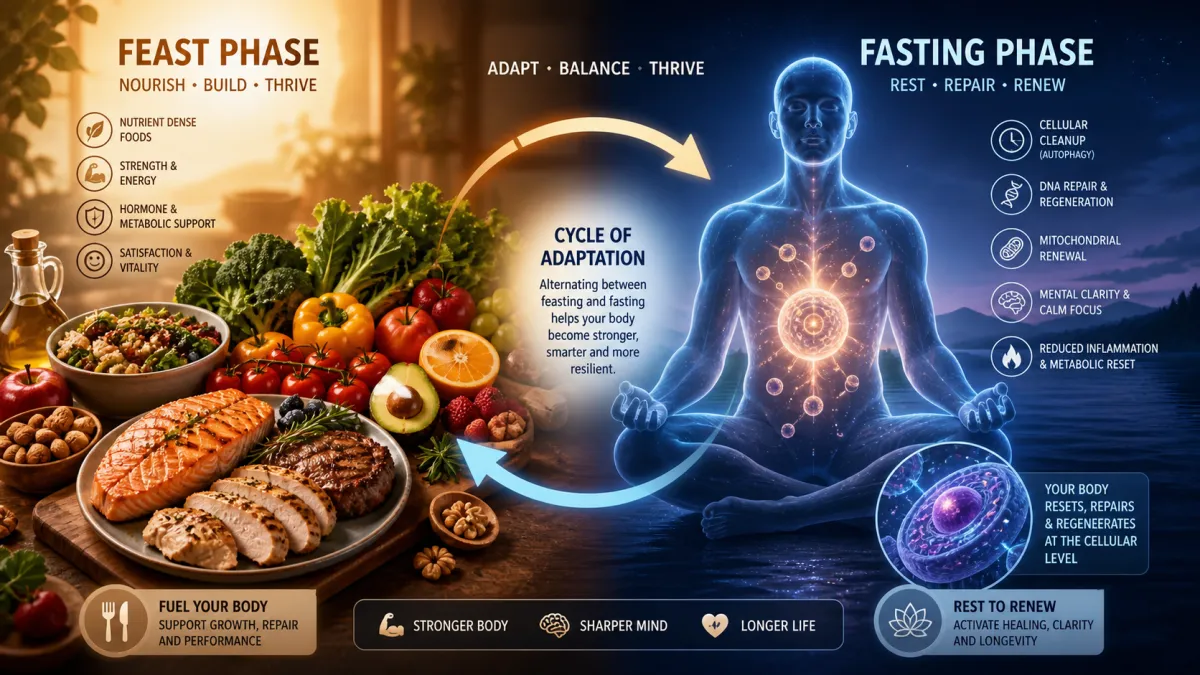
Diet Variation: Unlock Fat Loss and Hormone Balance with Feast-Famine Cycling
If you’ve tried different diets and still feel stuck, you’re not alone.
Many people bounce between strategies—low carb, keto, fasting—hoping one will finally work. But the real breakthrough doesn’t come from choosing one diet.
It comes from diet variation.
Diet variation is the strategic cycling between periods of eating and fasting—also known as feast-famine cycles—and it may be one of the most powerful ways to restore metabolism, balance hormones, and support cellular healing.
What Is Diet Variation?
Diet variation is not about eating a wide variety of foods.
It’s about changing how much and when you eat.
This approach mimics ancestral patterns where humans naturally cycled between:
Periods of abundance (feasting)
Periods of scarcity (fasting)
These cycles created a powerful adaptive response in the body.
Today, most people are stuck in one extreme—and that’s where problems begin.
The Problem: Being Stuck in One Mode
Your body thrives on adaptation.
But when you stay in one state too long, your body adjusts—and progress stalls.
Stuck in Feast Mode
Modern life makes food constantly available.
This leads to:
Frequent eating
Constant digestion
Lack of metabolic flexibility
When your body is always fed, it stays in growth mode and never shifts into repair mode.
This can lead to:
Increased inflammation
Weight gain
Higher disease risk
Stuck in Fast Mode
On the other side, some people stay in prolonged low-carb or fasting states.
While this can work initially, over time it can backfire.
Your body adapts by:
Slowing metabolism
Increasing fat storage
Raising insulin through internal glucose production
This can lead to:
Weight loss plateaus
Hormone imbalances
Increased belly fat
Your body is smart—it adapts to survive.
Why Diet Variation Works
The power of diet variation lies in forcing adaptation.
When you alternate between feast and famine:
Hormones reset
Metabolism becomes flexible
Fat burning improves
Cellular repair increases
This constant shift prevents stagnation.
The Science Behind Feast-Famine Cycles
Research on fasting and calorie cycling shows powerful benefits, including:
Improved metabolic health
Enhanced brain function
Reduced inflammation
Increased fat loss while preserving muscle
These cycles stimulate processes like:
Autophagy (cellular cleanup)
Stem cell regeneration
Hormonal optimization
This is where true healing begins—at the cellular level.
Benefits of Diet Variation
When implemented correctly, diet variation can:
Promote fat loss
Increase lean muscle
Improve cognitive performance
Support hormone balance
Reduce inflammation
Lower disease risk
It’s not about restriction—it’s about rhythm.
Are All Carbs the Same?
Not all carbs are created equal.
During feast phases, the quality of carbohydrates matters.
Best Carb Sources
Yams
Squash
Pumpkin
Wild rice
Fruits
These provide nutrients without the harmful effects of processed foods.
What to Avoid
Refined sugars
Processed grains
GMO foods
Chemical-laden products
Even during feast phases, food quality impacts results.
How to Implement Diet Variation
There are three main ways to apply this strategy.
1. Seasonal Variation
This approach mimics nature.
Winter: lower carb, higher fat
Summer: higher carb, more variety
This aligns with ancestral eating patterns.
2. Monthly Variation
This involves structured fasting cycles.
For example:
5 days of reduced calorie intake
Followed by normal eating
This approach supports:
Cellular regeneration
Metabolic reset
3. Weekly Variation
This is the most practical for most people.
Common patterns include:
5-1-1: 5 days low carb, 1 fasting day, 1 feast day
4-2-1: 4 low carb, 2 fasting, 1 feast
3-2-2: 3 low carb, 2 fasting, 2 feast
These cycles keep your body adapting consistently.
How to Choose the Right Approach
Your strategy should match your current health.
If you are:
Healing → include more feast days
Advanced → incorporate more fasting
The key is sustainability.
The Role of Hormones in Diet Variation
Hormones respond quickly to changes in diet.
Feast phases:
Boost leptin
Support thyroid function
Fasting phases:
Improve insulin sensitivity
Increase fat burning
This balance creates optimal hormonal function.
Breaking Through Weight Loss Resistance
If you’ve hit a plateau, your body has adapted.
Diet variation disrupts that adaptation.
By switching fuel sources and calorie intake, you:
Reset metabolism
Improve insulin sensitivity
Unlock fat loss
This is often the missing piece for stubborn weight.
Beyond Diet: The Principle of Adaptation
The concept of variation applies beyond food.
Your body responds to:
Temperature changes (hot/cold exposure)
Exercise variation
Stress cycles
Adaptation is the key to resilience.
Common Mistakes to Avoid
Staying in keto too long
Fasting excessively without refeeds
Ignoring food quality
Forcing aggressive protocols
Balance always wins.
What to Expect When You Start
As your body adapts, you may notice:
Improved energy
Better focus
Reduced cravings
Easier weight management
These are signs of metabolic flexibility.
The Bigger Picture: Cellular Healing Through Adaptation
Diet variation supports healing at the deepest level.
It:
Enhances cellular repair
Supports detox pathways
Improves mitochondrial function
This is how you move from symptom management to root-cause healing.
Final Thoughts: The Power of Change
People often ask, “What’s the best diet?”
The truth is:
There is no single perfect diet.
The magic is in the change.
When you give your body variety, you give it the opportunity to adapt, reset, and heal.
Your body was designed for this rhythm.
And when you work with it—not against it—you unlock a new level of health, energy, and vitality.